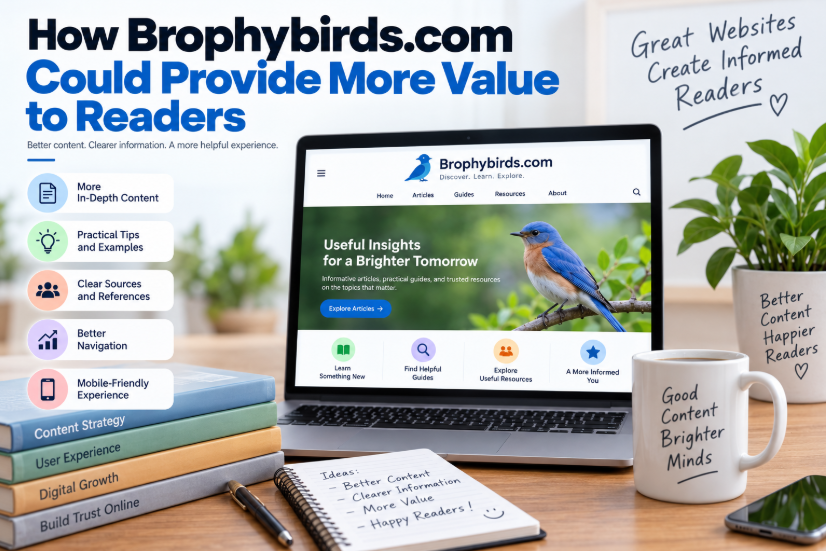
How Brophybirds.com Could Provide More Value to Readers
A website becomes more valuable when it gives visitors practical information that is easy to understand, relevant to their needs, and useful beyond the first visit. For a platform such as Brophybirds.com, there are several ways to improve the reader experience and make its content more helpful.
Whether visitors arrive through search engines, social media, or direct links, they generally want quick access to reliable information without having to search through unnecessary pages. Improving content depth, organization, transparency, and usability could help Brophybirds.com create a stronger experience for its audience.
1. Publish More Detailed and Useful Content
One of the simplest ways Brophybirds.com could provide additional value is by developing comprehensive articles around topics that readers are already interested in.
Instead of producing short pages that only provide basic information, articles could include:
- Step-by-step explanations
- Practical examples
- Frequently asked questions
- Advantages and limitations
- Comparison tables
- Expert recommendations with proper attribution
- Helpful resources for further research
Detailed content gives readers a reason to stay on the website longer and return when they need additional information.
2. Focus on Reader Intent
Not every visitor arrives with the same objective.
Someone searching for a definition may want a short explanation, while another reader may be looking for an in-depth guide. Brophybirds.com could improve its usefulness by creating content for different stages of the reader journey.
For example, content could be organized into:
| Reader Need | Suitable Content |
|---|---|
| Quick information | Short explanations and definitions |
| Learning | Detailed guides and tutorials |
| Comparison | Tables and side-by-side analysis |
| Research | Sources, references, and statistics |
| Decision-making | Benefits, limitations, and considerations |
| Troubleshooting | Step-by-step solutions |
This approach can make the website easier to navigate while giving visitors information that matches their specific intent.
3. Add Clear Sources and References
Readers often want to know where important information comes from.
When an article discusses statistics, research findings, technical claims, or other factual information, Brophybirds.com could add links to reputable external sources.
Useful references might include:
- Government websites
- Academic institutions
- Research publications
- Established industry organizations
- Official documentation
- Recognized professional associations
Providing sources does not simply make an article look more professional. It also gives readers an opportunity to investigate important claims themselves.
4. Keep Information Updated
Online information can become outdated surprisingly quickly.
Old statistics, discontinued products, changed regulations, outdated software instructions, and expired recommendations can reduce the usefulness of an otherwise well-written article.
Brophybirds.com could add visible “Last Updated” dates to appropriate articles and periodically review older content.
An effective content-maintenance process could include:
- Checking important facts.
- Updating outdated statistics.
- Replacing broken links.
- Reviewing screenshots and instructions.
- Removing obsolete recommendations.
- Adding new developments when relevant.
Regular updates would make older articles more useful to returning visitors.
5. Improve Website Navigation
Good information becomes less useful when visitors cannot find it easily.
Brophybirds.com could organize content into logical categories and provide clear navigation throughout the site.
Helpful features could include:
- Topic categories
- Search functionality
- Related article suggestions
- Breadcrumb navigation
- Clearly labeled menus
- Topic-specific landing pages
- Popular article sections
A well-organized structure can help readers discover related information without repeatedly returning to a search engine.
6. Use Visual Content Where Appropriate
Text is important, but visual material can make complicated subjects easier to understand.
Depending on the topic, Brophybirds.com could use:
- Infographics
- Original illustrations
- Screenshots
- Diagrams
- Charts
- Comparison tables
- Short instructional videos
Visual elements should support the written content rather than simply decorate the page.
For example, a step-by-step tutorial can often become much easier to follow when each major step includes an appropriate screenshot or diagram.
7. Make Articles Easier to Scan
Many internet users do not read every paragraph from beginning to end. They scan headings, lists, highlighted information, and tables before deciding whether an article contains what they need.
Brophybirds.com could improve readability by using:
- Short paragraphs
- Descriptive headings
- Bullet points
- Numbered instructions
- Summary sections
- Tables
- Important takeaways
This structure can make longer articles easier to navigate on both desktop computers and mobile devices.
8. Provide More Original Insights
Another way to increase reader value is to move beyond information that can easily be found on hundreds of other websites.
Instead of simply rewriting common information, Brophybirds.com could offer original perspectives through:
- Case studies
- Real-world examples
- First-hand testing
- Original research
- Data analysis
- Expert interviews
- Practical experiments
Original material gives readers a reason to visit the website instead of relying on generic search results.
9. Be Transparent About Content
Transparency can help readers understand how information is produced.
Where appropriate, Brophybirds.com could provide:
- Author names
- Author biographies
- Editorial guidelines
- Publication dates
- Update dates
- Sources
- Disclosure statements
- Contact information for corrections
An article written by a named specialist, supported by relevant references, can provide more context than an anonymous page with no indication of how the information was produced.
10. Add Useful FAQs
Frequently asked questions can make articles significantly more practical.
An FAQ section could answer common questions that readers might have after reading the main article.
For example:
What is Brophybirds.com about?
A concise explanation could help first-time visitors understand the website’s purpose.
How often is the content updated?
Providing a clear answer can help readers understand how current the information may be.
Can readers suggest topics?
If the website accepts suggestions, explaining the process could encourage greater audience participation.
FAQs can also help readers find answers without searching through an entire article.
11. Encourage Responsible Reader Interaction
A website can become more useful when visitors have opportunities to provide feedback.
Brophybirds.com could potentially offer:
- Comment sections
- Topic suggestions
- Contact forms
- Content correction requests
- Reader surveys
- Feedback buttons
Reader feedback can help identify confusing explanations, outdated information, and topics that deserve further coverage.
If comments are enabled, appropriate moderation would also be important to maintain useful discussions.
12. Make the Mobile Experience a Priority
A significant portion of web browsing happens on smartphones and tablets. Therefore, a website’s mobile experience can have a major effect on how useful its content feels.
Brophybirds.com could focus on:
- Fast-loading pages
- Responsive layouts
- Readable font sizes
- Simple navigation
- Properly sized images
- Easy-to-use buttons
- Minimal intrusive pop-ups
A reader should not have to zoom in repeatedly or struggle with horizontal scrolling just to read an article.
13. Balance Information With Simplicity
More information does not always mean more value.
An article containing thousands of words can still be unhelpful if it repeats the same points or hides the main answer beneath unnecessary text.
Brophybirds.com could focus on depth without unnecessary repetition.
A strong article might follow this structure:
Quick answer → explanation → supporting details → examples → important considerations → FAQs → further resources
This gives readers the information they need while allowing those who want additional detail to continue reading.
14. Create Topic Hubs
Instead of treating every article as an isolated page, Brophybirds.com could create topic hubs that connect related content.
For example, a topic hub could contain:
- Beginner’s guide
- Advanced guide
- Common questions
- Comparisons
- Tutorials
- Latest updates
- Recommended resources
This structure helps readers move naturally from introductory information to more detailed material.
15. Build Trust Through Consistency
Providing value is not only about individual articles. Consistency matters too.
Readers are more likely to return when a website consistently provides:
- Clear information
- Predictable quality
- Accurate references
- Useful updates
- Transparent authorship
- Easy navigation
A consistent publishing approach can gradually establish a stronger relationship between the website and its audience.
Final Thoughts
There are several ways Brophybirds.com could provide more value to readers, from improving article depth and adding trustworthy references to creating better navigation and maintaining older content.
The most important principle is to focus on the actual needs of visitors. Readers generally want information that is clear, useful, current, and easy to verify.
By combining detailed content with practical examples, transparent sourcing, visual resources, FAQs, mobile-friendly design, and regular updates, Brophybirds.com could create a more informative experience for both new and returning visitors.
Ultimately, valuable content is not simply about publishing more pages. It is about giving readers better reasons to trust, understand, and return to the information they find.